
Last updated October 16, 2026
 AC repair
 Furnace & heating
 Heat pumps
 Ductless mini splits
 Carrier
 Trane
Trane Goodman
Seasonal tune-up and full diagnostic on your Carrier, Trane, or Goodman system - readings shown to you before any repair is proposed
Diagnosis first, numbers second - you approve the repair price before a single part goes in.
Get your free estimateAC Repair Maintenance Checklist for Los Angeles Homeowners
Here’s a number that surprises most Los Angeles homeowners: in parts of the San Fernando Valley and the Los Angeles Basin, an air conditioner can log 2,400 to 3,000 hours of runtime in a single year. The national average for a home AC system sits closer to 1,000 to 1,500 hours. That means a system cooling a home in Los Angeles ages roughly twice as fast as the “typical” unit every maintenance guide on the internet is written for. And that’s the core problem with most AC checklists you’ll find online. They’re written in a vacuum, as if every climate behaved like the Midwest or the Northeast. Los Angeles is different, and not just because summers are hot. The marine layer, the Santa Ana winds, the wildfire smoke, and the fact that your AC rarely gets a true off-season all change what maintenance should actually look like. This guide is built around those real Los Angeles triggers. You’ll learn what to check after every wind event, how often to truly replace filters here, where homeowners cross the line into work that voids warranties, and how to build a paper trail that protects a repair guarantee.
Quick Answer
A proper AC maintenance routine for a Los Angeles homeowner isn’t two annual tune-ups. It’s a running checklist organized around four local triggers: the marine layer, Santa Ana wind events, wildfire smoke windows, and near-constant system runtime. Plan to replace or clean your filter every 30 to 45 days during smoke and Santa Ana season, inspect the condenser coil and fins after every major wind event, and have a licensed technician perform a full system check at least twice a year through our AC Repair services, with one of those visits ideally in late spring before the first real heat wave. This approach catches the failures that a generic “spring and fall” schedule misses.
Styles & brands we work with
Table of Contents
- Why Los Angeles Breaks the Seasonal Checklist
- Filter Replacement Tied to LA Air Quality Events
- What to Inspect on the Condenser Unit After Every Santa Ana Wind Event
- Coil Cleaning Intervals for Systems Running 10+ Months Per Year
- Three Checks Homeowners Can Do Themselves Versus Five That Require a Licensed Technician
- How to Document Every Maintenance Visit So a 365-Day Repair Guarantee Has a Clear Paper Trail
- When to Call a Professional
Why Los Angeles Breaks the Seasonal Checklist
Walk into any hardware store in Los Angeles and you’ll see the same maintenance guides being sold that people buy in Minneapolis or Boston. They almost all say the same thing: schedule a tune-up in the spring before cooling season, and again in the fall before heating season. The logic works fine in a climate where the AC gets a genuine four-month winter nap. In Los Angeles, that nap doesn’t happen. An AC system in Woodland Hills or Pasadena can run in December. It can run in January. It can run the day after what passes for a “cold snap” here, because by 2:00 p.m. the interior of a west-facing house has climbed back to 78 degrees. There is no true off-season for cooling equipment in Los Angeles. That’s the first reason the twice-a-year model falls short.
The second reason is that Los Angeles has environmental events that stress HVAC equipment in ways that a calendar-based checklist never accounts for. A single Santa Ana wind event can pack a condenser coil with enough dry brush, leaf debris, dust, and fine grit to choke airflow within 72 hours. The marine layer, which sits over coastal neighborhoods from Santa Monica to San Pedro for weeks at a time in late spring and early summer, drives up relative humidity and creates exactly the damp environment where mold and mildew grow on evaporator coils and inside ductwork. Wildfire smoke doesn’t just dirty a filter; it loads it with fine particulate and acidic compounds that corrode coil surfaces and foul blower motors. None of those events respect a seasonal schedule.
What Los Angeles homeowners actually need is a trigger-based maintenance routine, as explained in The Complete Guide to HVAC in Los Angeles: check specific things after specific events, rather than waiting for a date on the calendar. The date still matters, of course. We recommend a full professional system check every spring before the first serious heat wave, and another in the fall before the shorter days and cooler nights change how the system cycles. But the trigger checks between those visits are what keep a Los Angeles AC from limping between tune-ups.
For a deeper look at what a full professional service visit includes in this market, see our guide to AC Repair in Los Angeles.
Filter Replacement Tied to LA Air Quality Events
Here’s the most common mistake we see in Los Angeles homes: a homeowner buys a high-MERV filter, installs it in March, and doesn’t think about it again until August, because that’s what the filter packaging says to do. The packaging says “replace every 90 days” because that’s roughly right for a house in a climate with seasonal pollen and average dust. But Los Angeles air is not average, and two specific local conditions dramatically shorten filter life.
The first is Santa Ana season, which typically runs from September through November but can stretch into December. During a Santa Ana event, winds funnel dry desert air through the mountain passes and across the basin at 30 to 50 mph, sometimes higher. That air carries fine dust, pollen, and gritty particulate from the high desert directly into your outdoor condenser unit and, through open windows and door gaps, into your home. A filter that had two more months of life left on September 1st can be completely loaded by October 15th. The second condition is wildfire smoke. When smoke settles over Los Angeles, which has happened with increasing frequency in recent years, the filter in your return grille is doing a real filtration job, pulling soot and fine particulate out of the air before it reaches your evaporator coil. That’s good for your coil, but it means the filter fills up far faster than normal.
Here’s a practical replacement schedule based on what we’ve observed in Los Angeles:
- Standard 1-to-2-inch fiberglass filter: every 30 days, regardless of season, if the system runs daily.
- Standard 1-to-2-inch pleated filter (MERV 8 to 11): every 45 to 60 days during normal Los Angeles conditions; every 30 days during Santa Ana season or a wildfire smoke event.
- High-MERV pleated filter (MERV 12 to 13): every 60 to 90 days in normal conditions, but check it weekly during smoke events and after every Santa Ana wind episode. These filters load up faster because they catch more.
One note of caution: if you’re tempted to jump to the highest MERV rating available because Los Angeles air worries you, talk to a technician first. Some older systems, particularly older furnaces and air handlers, can’t handle the airflow restriction of a MERV 13 filter. Putting a very dense filter in an older system drops airflow, makes the system work harder, and can cause the evaporator coil to freeze. A MERV 8 to 11 pleated filter is the right call for most Los Angeles homes.
What to Inspect on the Condenser Unit After Every Santa Ana Wind Event
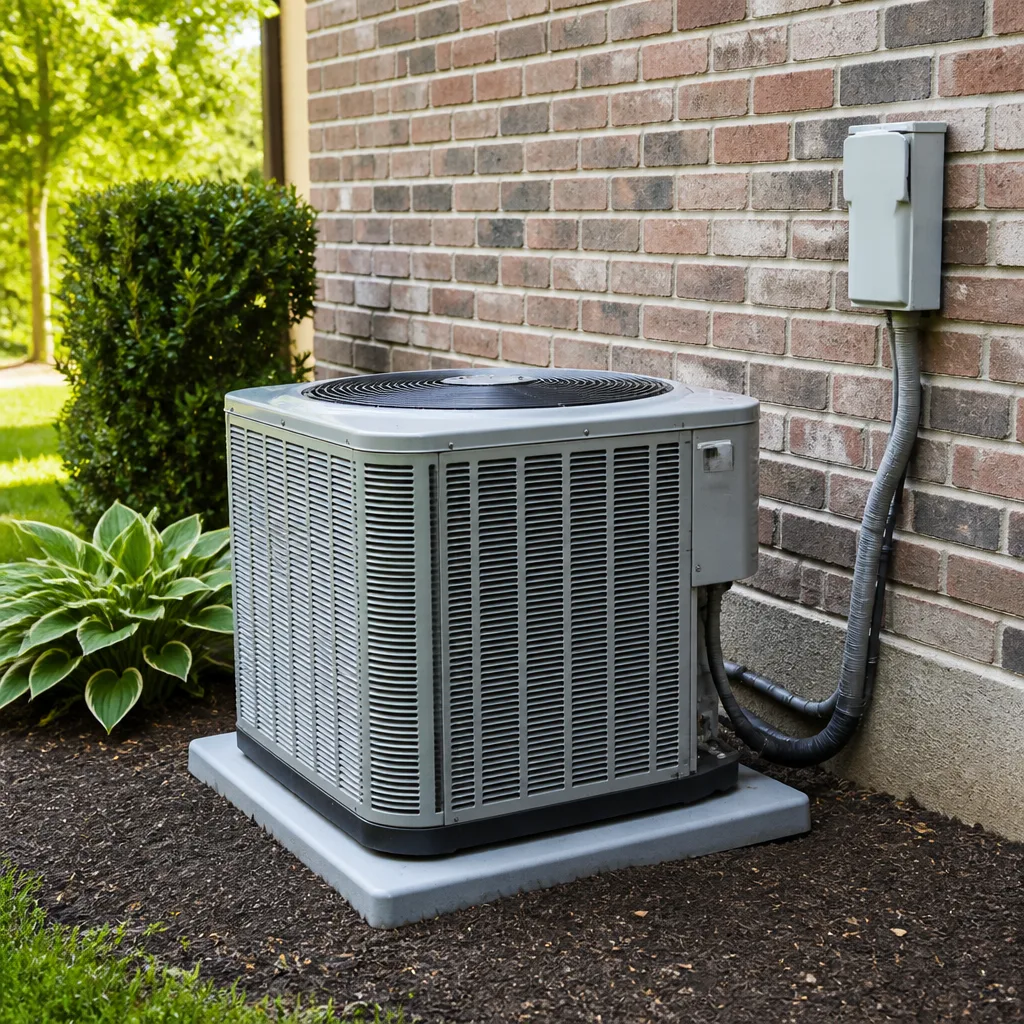
The outdoor condenser unit is the part of your AC that sits outside, usually on a pad next to the house or on the roof. It’s a box with a fan on top and a coil wrapped around the outside. That coil is the system’s heat exchanger: it’s how your AC dumps the heat it pulled out of your house into the outside air. And that coil is the single most abused component during Santa Ana wind season.
A Santa Ana wind event doesn’t just blow; it scours. It picks up dry leaves from sycamore and oak trees, palm fronds, loose soil, construction dust, and whatever else is loose in the neighborhood and drives it horizontally into the side of your outdoor unit. Within hours, the coil can be matted with enough debris to reduce airflow through the coil by 30, 40, even 50 percent. When airflow drops that much, the system’s head pressure climbs, the compressor runs hotter, and efficiency falls off a cliff. Left unaddressed through a windy October and November, that kind of debris loading is exactly what leads to compressor failures in December, right when Los Angeles homeowners are least expecting a cooling problem.
After every significant Santa Ana event, take five minutes and do this:
- Walk around the condenser unit and look for debris matted against the coil. Leaves, grass clippings, palm fronds, paper, plastic bags. Anything pressed against the coil surface is blocking airflow.
- Check for anything leaning against the unit. Trash cans blown over, yard furniture, pool toys. The unit needs at least two feet of clear space on all sides to breathe.
- Look for visible bent fins on the coil. The fins are the thin aluminum slats that make up the coil surface. Wind-driven debris can bend them flat, and bent fins block airflow even when no debris is present.
- Listen for anything rattling inside the unit when the system turns on. Wind can loosen screws, dislodge panels, or push debris into the fan blades.
If you find bent fins, you can straighten them with a fin comb from a hardware store, but be gentle. The aluminum is soft. If the bending is extensive, or if the coil is packed with debris deep between the fins, don’t try to dig it out with a screwdriver. You’ll cause more damage. That’s a job for a technician who can pull the coil apart, clean it properly, and check the system’s refrigerant pressures afterward.
One more Santa Ana note: if you have a rooftop condenser, which is common in older Los Angeles homes, don’t climb up to check it after a wind event unless you have a safe roof access and proper fall protection. Most Los Angeles rooftops are not built for casual foot traffic. We regularly see homeowners who’ve caused serious roof damage or worse by trying to inspect rooftop units themselves. If you can’t reach the unit safely, call a professional. This is a safety issue, not a convenience issue.
Coil Cleaning Intervals for Systems Running 10+ Months Per Year
National HVAC maintenance guidance typically recommends professional coil cleaning once a year, maybe twice in dusty climates. For most of the country, that’s adequate, because the system runs for four or five months and then rests. For a Los Angeles system, that interval is too long. Here’s why.
Your evaporator coil sits inside the air handler, usually in a closet, attic, or garage. Air from your home gets pulled across this coil, and the cold refrigerant inside the coil absorbs heat from the air. The coil is wet almost constantly while the system runs; condensation forms on it just like water beads on a cold glass. That wet surface is a magnet for whatever is in your air: dust, pet dander, cooking grease, smoke particulate, hairspray. Over months of near-constant runtime, that gunk builds up on the coil surface and does two things. First, it insulates the coil, which means the refrigerant can’t absorb heat as efficiently. Second, it provides a food source and a damp home for mold and bacteria, which is how you end up with that musty “dirty sock” smell coming out of your vents.
In a Los Angeles system that runs ten, eleven, twelve months out of the year, we recommend a professional coil cleaning every 12 to 18 months, not every 24. Coastal neighborhoods get hit worse than inland ones because the marine layer keeps humidity high for weeks at a time, which accelerates biological growth on the coil. Homes with pets should lean toward the shorter end of that interval, because pet dander plus constant moisture is a particularly stubborn combination.
This is not a DIY job, despite what the spray-bottle coil cleaners at the hardware store suggest. The coil is buried inside the air handler, and getting to it requires disassembling panels, moving drain lines and wiring, and in many Los Angeles homes, working in a hot attic or a tight closet. A proper cleaning requires removing the coil or using professional-grade cleaners and rinses that won’t strip the protective coating off the aluminum. If you spray the wrong chemical on a coil and it doesn’t get fully rinsed, you can cause corrosion that shortens the coil’s life by years. This is technician work, plain and simple.
Three Checks Homeowners Can Do Themselves Versus Five That Require a Licensed Technician
Let’s be direct about something that most online guides dance around: there’s a clear line between what a Los Angeles homeowner can safely and legitimately check on an AC system and what crosses into work that should be left to a licensed professional. Cross that line and you risk personal injury, equipment damage, and quietly voiding the warranty on a compressor or coil that could have been replaced for free. For a deeper look at where to draw that line, see DIY vs Professional HVAC: The Los Angeles Homeowner’s Decision Guide. Here’s exactly where that line sits.
The three things you can do yourself:
- Check and replace the air filter. This is the simplest, highest-impact maintenance task there is. You don’t need any training to pull a filter out of a return grille, look at it against a light, and decide whether it’s loaded. A dirty filter is the leading cause of frozen coils and reduced airflow in residential systems.
- Keep the area around the outdoor condenser unit clear. Trim vegetation back at least two feet on every side. Pick up leaves, palm fronds, and trash, especially after a wind event. This costs nothing and prevents the single most common airflow problem we see.
- Check the condensate drain line for standing water or obvious blockages. If you have a visible condensate drain with an access point near the indoor unit and it’s backing up with water, you can sometimes clear a clog with a wet/dry vacuum on the end of the line. But be careful: if the line is glued PVC and you start yanking on it, you can crack a fitting and create a leak inside a wall. If you don’t feel comfortable, don’t touch it.
The five things that require a licensed technician:
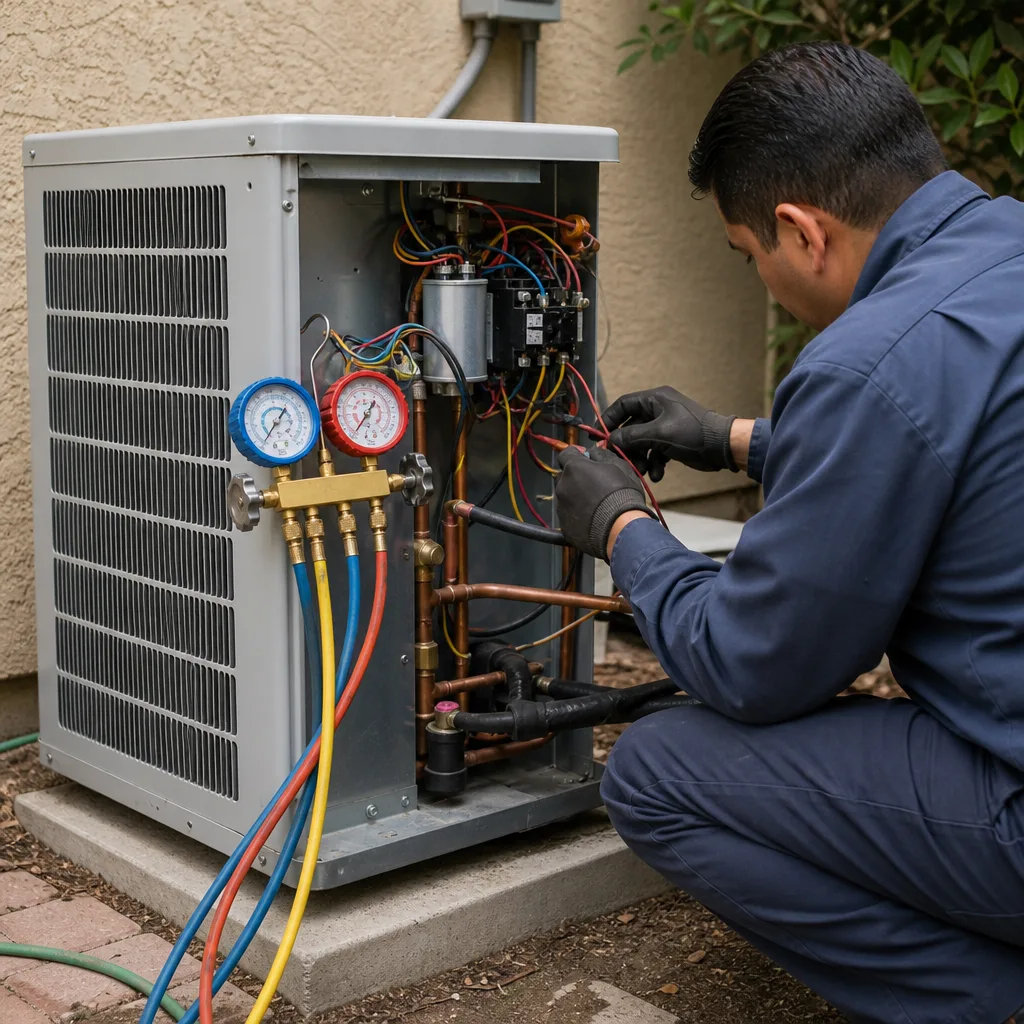
- Anything involving refrigerant. Adding refrigerant, checking refrigerant pressure, finding a refrigerant leak. This is the biggest one. Federal law requires anyone handling refrigerant to hold an EPA Section 608 certification. More practically, if your system is low on refrigerant, it’s low because there’s a leak. Adding refrigerant without finding and fixing the leak is a temporary fix that wastes money and damages the system over time. And opening the refrigerant lines yourself will void the warranty on the compressor and coil with almost every manufacturer, including Carrier, Trane, American Standard, and Bryant.
- Any electrical work inside the air handler or condenser unit. The capacitor in your outdoor unit holds enough stored voltage to stop a heart even with the power off. Capacitors, contactors, motors, and control boards are all live-voltage components. This is not a “watch a YouTube video and give it a shot” situation. Homeowners are killed every year by AC electrical work.
- Opening the sealed refrigerant system. The sealed system includes the compressor, the evaporator coil, the condenser coil, and the copper lines connecting them. This is a closed loop under pressure. Opening it releases refrigerant into the atmosphere (illegal) and lets moisture and air into the system, which leads to acid formation, compressor burnout, and complete system failure.
- Deep coil cleaning that requires removing access panels. We covered this above, but it belongs on the “technician only” list too. The evaporator coil is inside the air handler, often in a cramped attic or closet, surrounded by electrical wiring and refrigerant lines. A proper cleaning requires removal and specialized equipment. A homeowner with a spray bottle and a wire brush can do thousands of dollars in damage.
- Testing for carbon monoxide or cracked heat exchanger issues on a shared heating system. In most Los Angeles homes, the furnace and the AC share the same air handler and ductwork. If the furnace has a cracked heat exchanger, running the AC fan can circulate carbon monoxide through the house. Testing for this requires a combustion analyzer and a trained eye. This is not optional.
The underlying principle is simple: if it involves refrigerant, high voltage, sealed components, or gases that can kill you, it’s technician work. If it involves checking, cleaning, replacing a filter, and observing from the outside, it’s reasonable homeowner maintenance.
If any of the technician-only items describes what your system needs, see our page on AC Repair in Los Angeles to understand what a proper fix looks like, what it costs, and how a written guarantee works.
How to Document Every Maintenance Visit So a 365-Day Repair Guarantee Has a Clear Paper Trail
Here’s a scenario we see often in Los Angeles: a homeowner has a capacitor replaced in July, the repair comes with a written 365-day guarantee, and then the same capacitor fails in January. But when the homeowner calls to invoke the guarantee, they discover they can’t find the invoice. They don’t remember the date. They’re not sure which company did the work, because it was the previous owner’s HVAC company, or their spouse’s, or someone they found on a nextdoor post. The guarantee is real, but the paper trail is gone, and without documentation, enforcing it becomes a fight.
This is why documentation matters as much as the maintenance itself. And it’s not hard. You just need a system. Here’s what we recommend:
- Keep a dedicated folder, physical or digital, for every HVAC invoice and service record. Every time anyone works on your system, the invoice goes in the folder. No exceptions. If the technician hands you a paper invoice, snap a photo of it with your phone before it gets lost in a pile on the kitchen counter.
- Write the date of every filter change on the filter itself with a permanent marker. This gives you an instant visual record of how fast your filter is loading up, and it’s useful information to share with a technician.
- Note every maintenance visit in a simple log. Date, what was done, who did it, what they said. Three lines is enough. “March 14, 2025. Coil cleaned, capacitor tested, filter replaced. Technician noted slight rust on the drain pan, will watch it.” That kind of note, saved over years, is invaluable when a system ages and you’re trying to decide whether to repair or replace.
- If a repair comes with a written guarantee, verify that the guarantee is actually on the invoice or a separate document before the technician leaves. A verbal promise doesn’t count. At Cold Harbour Heating and Air Los Angeles, every repair includes a written 365-day guarantee, and we make sure it’s printed on the paperwork we leave with the homeowner, not just mentioned in passing.
Here’s the thing about guarantees worth understanding: a guarantee only has value if the paperwork supports it. When you call a company to say “your repair failed,” the first thing they’ll ask for is the original invoice and the date of service. Having those in hand turns a ten-minute conversation into a “we’ll send someone out” conversation. Not having them turns it into a research project. For more guides & resources on keeping your system running smoothly, visit our blog.
This is also why we recommend building a relationship with one HVAC company rather than bouncing between whichever name comes up first in a search. When one company has your full service history, there’s no question about what was done, when, or by whom. That’s a real business reason, not just a convenience. It’s also one of the reasons we built Cold Harbour Heating and Air Los Angeles home service around the Kingswell Way: written pricing, a firm arrival window, a clean job site, and a 365-day written guarantee on every repair.
See the difference
 Before
 After
After Before
 After
After Before
 After
AfterCommon Mistakes to Avoid
- Treating the marine layer as a non-event. Many Los Angeles homeowners think of the May and June coastal overcast as mild weather that doesn’t stress the AC. But the humidity it brings is exactly what encourages mold growth on evaporator coils and inside ductwork. In coastal neighborhoods like Playa del Rey and San Pedro, a system that runs humid air through its ducts for weeks on end without a coil cleaning is asking for a musty-smelling house.
- Waiting until the first heat wave to schedule a tune-up. The first serious Los Angeles heat wave, usually in June or July, is when every HVAC company in the city gets slammed. Book your annual service in April or May and you’ll get a better appointment window and a technician who isn’t rushing between calls.
- Ignoring the outdoor condenser unit between service visits. The condenser is outside, it’s easy to forget, and it’s the single most common point of failure in Los Angeles systems. Leaves, palm fronds, dirt, and wind-borne debris accumulate fast. A quick visual check during Santa Ana season costs nothing and prevents the majority of airflow problems.
- Using the wrong filter for the sake of “better air.” High-MERV filters on older systems cause airflow restriction, frozen coils, and compressor strain. Let a technician tell you what your specific system can handle before you upgrade filter density.
- Attempting refrigerant or electrical work without training. We’ve said it already but it bears repeating: opening refrigerant lines or touching capacitors without a license is illegal, dangerous, and voids every major manufacturer warranty, including those from Trane, Carrier, and Bryant.
- Not documenting maintenance and repairs. A written guarantee is only valuable if you can find it. File every invoice, write every date, keep every record. When a repair fails and you need to invoke a guarantee, the paperwork is the difference between a smooth correction and an argument.
When to Call a Professional
Some situations don’t belong on a DIY checklist, and knowing the difference is part of owning a home in Los Angeles. Call a licensed technician if your system is blowing warm air on a hot day, if the outdoor unit is making a grinding or screeching noise, if ice is forming on the refrigerant lines or on the indoor coil, if the breakers for the HVAC system keep tripping, or if you smell anything musty, burning, or gas-like coming from the vents. These are symptoms of problems that get worse and more expensive with every day they go unaddressed, not things that work themselves out. In extreme Los Angeles heat, a failed AC isn’t just uncomfortable; for elderly residents, infants, and people with respiratory conditions, it can be a serious health risk. Don’t wait it out. Cold Harbour Heating and Air Los Angeles offers free estimates in Los Angeles. Call (213) 531-5904 and a real person will answer, any hour, any day.
Frequently Asked Questions
For most Los Angeles homes, a pleated filter should be replaced every 45 to 60 days under normal conditions, and every 30 days during Santa Ana season or a wildfire smoke event. Homes with pets, homes near freeways or construction, and homes in very dusty inland neighborhoods like Sylmar or Sun Valley will run through filters even faster. A good rule: check the filter every two weeks and replace it when it looks dirty, not when the calendar says it’s time.
Yes, and in Los Angeles, twice a year is the minimum for professional service. The system may seem fine right up until a compressor fails or a coil freezes, and by then the repair is far more expensive than a tune-up would have been. The twice-a-year visits aren’t about fixing problems; they’re about finding small issues, like a weak capacitor or a slightly low refrigerant charge, before they cause failures. That’s cheap insurance on a system that runs year-round in Los Angeles.
After a Santa Ana event, inspect the outdoor condenser unit for debris matted against the coil, anything leaning against or blown into the unit, bent fins on the coil surface, and loose panels or screws. Clear the area around the unit by at least two feet on all sides. If you see extensive debris inside the coil or significant fin damage, call a technician. Don’t attempt to dig debris out of the coil with a sharp tool; that’s how coil leaks happen.
You can rinse the outdoor condenser coil gently with a garden hose if you first turn off the power at the breaker, but be cautious: the fins are fragile and high water pressure will bend them flat. The indoor evaporator coil is a different story. It’s buried inside the air handler, surrounded by wiring and refrigerant lines, and cleaning it properly requires removing access panels and using professional-grade cleaners. We don’t recommend homeowners attempt indoor coil cleaning. The risk of damage outweighs the savings almost every time.
Read the paperwork. A valid repair guarantee should be written on the invoice or a separate document, specify the scope of the repair, and state the guarantee period clearly. At Cold Harbour Heating and Air Los Angeles, every repair includes a written 365-day guarantee. If the repair fails within that window, we return and correct the work at no charge. If a company offers a guarantee verbally but won’t put it on paper, that guarantee isn’t worth the breath it took to say it.
It can, if it’s properly maintained. But “properly maintained” in Los Angeles means more frequent filter changes, more frequent coil cleaning, and trigger-based inspections after wind and smoke events, not just annual tune-ups. A system that runs 10 or 11 months out of the year accumulates wear about twice as fast as a system that runs seasonally. The maintenance schedule has to keep up with the runtime, or the system will fail early.
The Bottom Line
An AC maintenance checklist for Los Angeles homeowners has to account for what’s actually true about this city: the AC almost never rests, the air carries marine-layer humidity in spring and Santa Ana dust in fall, and wildfire smoke can turn a clean filter into a clogged one in a matter of days. The checklist that works here is built around those triggers, not around a national calendar. Check the filter monthly. Inspect the condenser after every wind event. Clean the coils every 12 to 18 months. Keep a written log of every service visit and every repair so any written guarantee has the paper trail it needs. And when something crosses into refrigerant, electrical, or sealed-system territory, call a professional. We’re local, we’ve been serving Los Angeles since 2003, and we answer the phone around the clock. For a free estimate, call (213) 531-5904.
Written by Victor Mancini, Owner at Cold Harbour Heating and Air Los Angeles, serving Los Angeles since 2003.